
Where to Buy the Best Barcode Printer Labels in China?

Where to buy the best barcode printer labels in China depends on how well a supplier matches your equipment, application, and order size. China has manufacturers, trading companies, and specialist label converters, but their offerings can differ in material quality and customization. A polished product page is not proof of consistent production. Small details matter.

Start by identifying the printer type and label conditions. Direct thermal labels suit many short-term uses, while thermal transfer labels require a compatible ribbon. Check the label width, core size, adhesive, and roll direction against your printer’s specifications. If labels face moisture, friction, or cold storage, explain those conditions before requesting a quotation. Ask for samples. Then print them on your own machine and check barcode clarity, feeding, and adhesion. A sample test can reveal problems a specification sheet misses.

When comparing Chinese suppliers, review their manufacturing experience, quality-control process, available materials, and response to technical questions. Request clear details on minimum order quantities, sample costs, production lead times, packaging, and shipping terms. For larger orders, discuss batch consistency and how defects are handled. Independent audits or relevant quality certificates can add useful evidence, but verify their scope and validity rather than relying on a logo alone. No checklist removes every risk. Even an experienced buyer can overlook a small mismatch, so document the agreed specifications before production. The best source is usually the one that communicates plainly, provides testable evidence, and delivers barcode printer labels suited to your actual workflow.
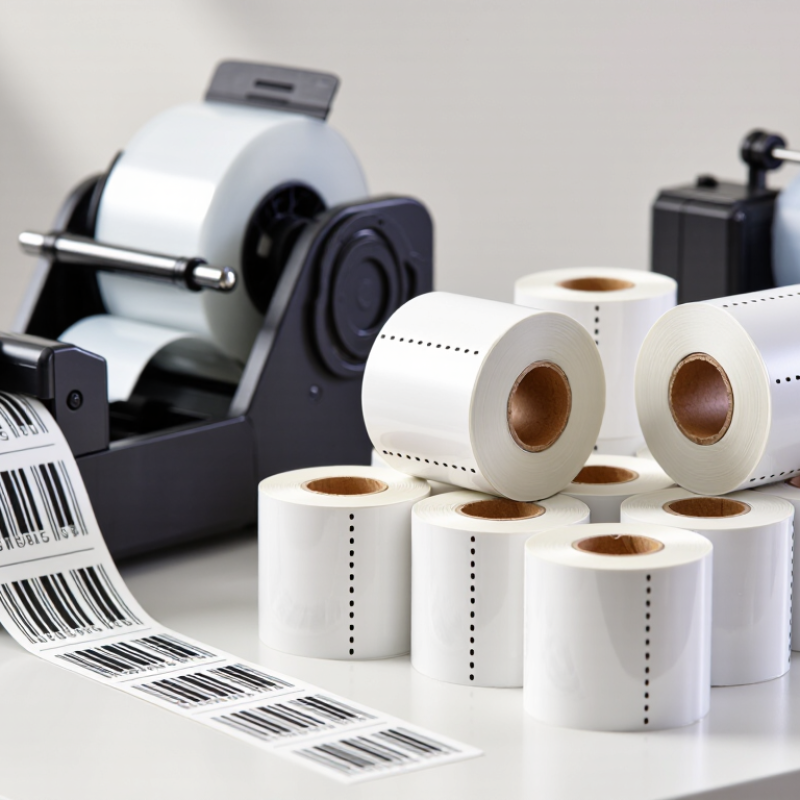
Where to Buy the Best Barcode Printer Labels in China?

Types of Barcode Printer Labels Available in China

Barcode printer labels in China range from simple paper rolls to durable synthetic stock. Direct thermal labels need no ribbon, so they suit shipping cartons, receipts, and short-term tracking. They print quickly. But heat and sunlight can fade the image, so they are less suitable for long storage or outdoor use.

Thermal transfer labels use a ribbon and usually last longer. Wax ribbons work well on coated paper for indoor shelves; resin-based ribbons are often chosen for synthetic materials and harsher conditions. Common label materials include paper, polypropylene, and polyester. Paper is economical, while polypropylene resists moisture and tearing; polyester handles more demanding environments. Adhesives matter too. Removable glue can protect temporary packaging, while permanent adhesive is better for fixed inventory labels. Cold rooms may need adhesive tested at low temperatures. Not every “freezer label” performs alike.

When comparing suppliers in China, share the printer model, label width, roll core size, and the surface temperature or storage conditions. Ask for samples and scan test barcodes after printing. A label that looks crisp on a desk may fail on a curved bottle or dusty carton. The choice is not always obvious; testing a small batch can prevent wasted rolls.

Types of Barcode Printer Labels Available in China

Typical face-stock thickness ranges for commonly used barcode label materials. Values are approximate; actual specifications vary by supplier.

Paper labels are common for general-purpose use, while PP and PET film labels are often chosen when greater moisture or abrasion resistance is needed. Compare the complete label construction and printer compatibility when sourcing.

Key Factors for Choosing a Reliable Label Supplier

Choosing a barcode label supplier in China starts with the label’s actual working conditions. Will it sit on a cool warehouse shelf or pass through a warm, dusty production area? Tell suppliers the printer type, label size, roll direction, core diameter, and expected daily volume. These details help them recommend suitable face stock and adhesive. A sample roll is more useful than a polished product sheet. Test it on your own printer. Check whether barcodes scan clearly, edges stay flat, and labels peel cleanly after storage. Small details matter.

A reliable supplier should answer technical questions clearly and provide consistent specifications for repeat orders. Ask how they check coating, adhesive strength, roll winding, and print quality. Request a written sample specification, then compare delivered rolls against it. Also discuss lead times, minimum order quantities, packaging, and how production changes are communicated. A low quote can look convincing, but a small adhesive mismatch may slow an entire packing line. I would not judge reliability from one smooth conversation; that can be a mistake. Keep records of sample tests and order details, and note any issue, even a minor one. Some checks take time. Better to find that out before ordering at scale.

Where to Buy the Best Barcode Printer Labels in China? — Key Factors for Choosing a Reliable Label Supplier

Buying Channel or Factor What to Check Why It Matters Practical Verification
Direct label manufacturer Printing and converting capabilities, material options, quality controls, and experience with your label format Direct sourcing may provide more control over specifications and custom converting, but capabilities differ by supplier. Request a sample made to your dimensions and confirm which production steps are performed in-house.
Industrial packaging or label distributor Available stock sizes, technical support, order quantities, and delivery coverage A distributor may be useful for standard products or smaller, more frequent orders. Ask for the product specification sheet, stock status, and written lead-time and order-quantity terms.
Online B2B marketplace Supplier verification details, transaction terms, sample availability, and dispute or payment protections Marketplaces can help identify potential suppliers, but a listing alone does not establish product quality or manufacturing capability. Compare multiple quotations, verify the legal business details, and evaluate samples before placing a production order.
Printing and barcode compatibility Printer type, print method, label width, roll direction, core size, and maximum roll diameter Labels must suit the printer and feed path. Thermal-transfer printing uses a ribbon; direct-thermal printing does not. Provide the printer model or its media specifications and test the label feed and barcode readability on the actual printer.
Face material and print method Paper or synthetic face stock, direct-thermal or thermal-transfer compatibility, and any required topcoat Paper is commonly used for general-purpose labeling; synthetic materials are often considered where greater moisture or abrasion resistance is needed. Test samples under the expected handling, storage, and exposure conditions; confirm ribbon compatibility for thermal-transfer labels.
Adhesive and application surface Permanent or removable adhesive, application temperature, surface type, and exposure to moisture or cold Adhesion depends on the label, surface, temperature, and environment; one adhesive is not suitable for every application. Apply samples to the actual packaging or product surface and check adhesion after the relevant storage or handling period.
Barcode quality and inspection Print contrast, edge definition, quiet zones, barcode dimensions, and scanning performance Readable barcodes depend on both label production and printer setup. A visually clear code may still fail a scanner or verification test. Print and scan a production sample; where required, use a barcode verifier and agree on the acceptance criteria before ordering.
Quality consistency and traceability Documented specifications, batch identification, inspection records, and a process for handling defects Consistent materials and dimensions help reduce feeding, printing, and scanning problems across repeat orders. Request a written specification and sample approval record, then confirm how production batches and nonconforming goods are handled.
Quotation, delivery, and export terms Price basis, tooling or setup charges, packaging, production lead time, shipping terms, and payment conditions A unit price alone may not include all costs or clarify delivery responsibilities. Compare quotations using the same label specification, order quantity, destination, and delivery terms.

Selection note: The best supplier depends on the printer, barcode requirements, label surface, operating environment, order volume, and delivery needs. Confirm specifications with samples before approving a bulk order.

Main Sourcing Channels for Barcode Labels in China

China’s barcode-label supply base includes direct label converters, trading companies, and regional packaging distributors. Direct manufacturers can handle custom widths, adhesive grades, core sizes, and repeat orders. Ask for a sample roll printed with your actual barcode, then test it on your printer and scanner. Small details matter.

Trading companies can coordinate several materials and manage export communication, but their factory access may vary. Request the production site, material specifications, and a recent batch record before comparing quotations. Online B2B marketplaces help build a shortlist; treat listings as leads, not proof of capacity. Regional wholesale markets are useful for checking common thermal labels, though customization may be limited. Check roll winding, label gaps, print clarity, and adhesive residue.

Industry exhibitions and local sourcing agents let you inspect samples in person. Still, a polished sample does not guarantee consistent production. Compare landed cost, minimum order quantity, lead time, and replacement terms in writing. Ask how the supplier handles faded printing, curling edges, or labels that lift in cold storage. A low quote may leave testing or packaging details unclear. Before placing a large order, can the supplier provide a pilot batch from the intended production line?

How to Verify Label Quality and Supplier Credentials

Where to Buy the Best Barcode Printer Labels in China?
How to Verify Label Quality and Supplier Credentials

When sourcing barcode printer labels in China, match the material to your printer and working conditions. Ask for a sample roll, not just a catalog photo. Print several labels at your usual speed, then scan them with your own readers. Check for edge lift, smudging, adhesive residue, and barcode readability after rubbing or brief exposure to heat and moisture. A low-cost label can still fail if its coating dulls scans or its adhesive softens in storage. Small details matter.

Request a technical data sheet listing the face stock, adhesive type, liner, and storage range. Compare it with the sample and written quotation; clarify any mismatch. Check the supplier’s registered name and address against relevant public business records. Confirm that invoices and payment details use consistent company information. A video call can show production equipment, packaging, and batch records, but it cannot replace independent checks.

Tips: Keep an approved sample as your reference. Record the test date, printer settings, and batch number. If results vary, pause a large order and request another batch.

Steps for Purchasing and Shipping Barcode Labels from China

Where to Buy the Best Barcode Printer Labels in China?

Start by writing down your printer type, label width, roll diameter, core size, and daily print volume. Choose direct thermal labels for short-term use, or thermal transfer labels when prints need greater resistance to heat or handling. Specify the adhesive and surface, too. A label for a cool warehouse may fail on a dusty carton.

Request a written quotation from several manufacturers or sourcing suppliers. Include material, dimensions, winding direction, quantity, packaging, production time, and shipping destination. Ask for samples before placing a large order. Test them on your own printer and packaging. Check barcode clarity, feed alignment, and whether labels peel cleanly. Small details matter. A sample can look fine by hand but jam during a long print run.

Before payment, confirm the approved specifications, delivery terms, and who arranges export transport. Ask for photos of packed rolls and the estimated dispatch date. For urgent shipments, air freight may be practical; larger orders often suit sea freight, with longer transit time. Keep the invoice, packing list, and tracking details together. Inspect the cartons on arrival, especially for crushed edges or moisture. I would not assume every production batch behaves exactly like the sample; record any differences and discuss them promptly with the supplier.

Back to top